
pos
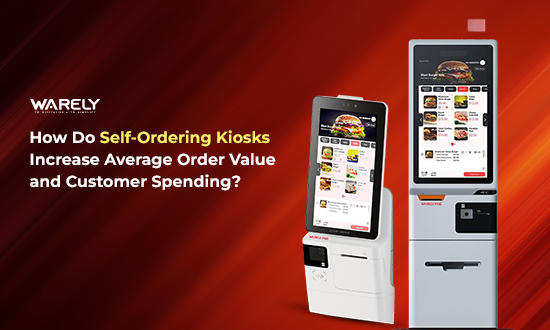
How Do Self-Ordering Kiosks Increase Average Order Value and Customer Spending?
Self-ordering kiosks consistently increase average order value by giving customers a more comfortable and engaging ordering experience. Unlike traditional counter ordering, kiosks remove social pressure, showcase menu items with high-quality visuals, and present personalised upsell opportunities throughout the ordering journey. This article explains the psychology behind higher customer spending, the role of visual menus and smart upselling, and how F&B businesses can increase revenue using self-ordering kiosk solutions such as Warely POS.
Contents

CEO, Warely
Read »
How a POS System Helps Run Flash Sales Without Pricing Errors | Warely POS
How Do Self-Ordering Kiosks Increase Average Order Value and Customer Spending?
Introduction: The Answer Is Simple. The Reason Is Fascinating.
At a counter, a customer’s order is brief. They don’t want to hold up the line. They feel watched. They say “just a burger and a Coke” and move on — even if they were thinking about adding fries or upgrading to a meal.
Put that same customer in front of a self-ordering kiosk, and everything changes. They scroll at their own pace. They see photos of every item. They accept an upsell without feeling pressured. They spend more — almost every single time.
This is not a small difference. Businesses that switch to self-ordering kiosks regularly see average order values jump by 20% to 40%. Some see even more. And it is not a coincidence — there are real, well-understood reasons why this happens.
In this blog, we break it all down. We look at the psychology behind it, the practical features that drive it, and the real results that Singapore F&B businesses have achieved using Warely POS kiosks. If you run a restaurant, a café, or any food and beverage business, this is worth reading.
The Psychology: No Judgement, No Rush
The biggest reason people spend more on a kiosk is simple: they feel no social pressure.
When you order from a human cashier, there is always a tiny but real sense of being observed. You worry about taking too long. You do not want to ask about every topping option. You do not want to look like you are being difficult. So you order quickly — and you order less.
A kiosk removes all of that. There is no one staring at you. There is no line building behind you. You can take your time. You can look at every option. You can ask yourself, “Do I want to add an egg?” — and say yes without feeling judged.
The “No Eye Contact” Effect
Research on consumer behaviour consistently shows that people are more willing to spend on indulgent items when they are not face-to-face with another person. The kiosk screen becomes a private, pressure-free space. That is the environment where upselling becomes natural rather than awkward.
Browsing Changes Buying
At a counter, customers usually already know what they want. At a kiosk, they browse. Browsing exposes them to items they did not plan to order — sides, drinks, desserts, combo upgrades. When they see it visually and it looks good, they add it. It is that straightforward.
Key insight: Customers are not “buying more” against their will. They are discovering options they genuinely wanted — they just never saw them clearly before.
Visual Menus: A Photo Is Worth an Extra $4
Text menus describe food. Visual menus sell food.
When someone reads “Crispy Chicken Burger — $9.50” they process it logically. When they see a high-quality photo of that same burger — golden crust, fresh lettuce, melted cheese — they respond emotionally. And emotional decisions lead to more spending.
Warely POS kiosks display your full menu with vibrant, customisable photos for every item. The moment a customer sees your bestsellers presented beautifully, they are already more likely to add extras. They will see the loaded fries next to the burger and think, “That looks good. I’ll get that too.”
Item Visibility Drives Discovery
Many F&B businesses have great items that barely sell — not because customers don’t want them, but because they never see them. A verbal menu or a printed board with small text hides your inventory. A full-screen kiosk puts everything front and centre. Items that were invisible become visible, and suddenly they start selling.
Limited-Time Items and Promotions
Kiosks let you highlight seasonal specials, bundle offers, and promotional items with banners and featured placement. Customers cannot scroll past a well-placed deal without noticing it. This alone drives meaningful order value increases during promotional periods.
Warely POS feature: Update your menu photos, pricing, and featured items in real time from a single dashboard — no reprinting, no downtime.
Smart Upselling: Every Customer, Every Order, Every Time
Ask any restaurant owner about upselling and they will tell you the same thing: staff do not do it consistently. Some staff are confident. Some are shy. Some forget. Some are too busy. The result is upselling that is random and unreliable.
A kiosk does not have this problem. It upsells every single customer, every single order, every single time — with exactly the right message, presented at exactly the right moment.
How Kiosk Upselling Works
When a customer adds a main item, the kiosk automatically suggests a matching side or drink. When they are about to check out, it asks if they want to add dessert. When they select a regular drink, it offers a size upgrade for a small price difference. These prompts are built into the ordering flow.
Because the suggestions are contextual and visual — showing a relevant item with a photo and a small price difference — customers accept them at a much higher rate than when a cashier asks the same question verbally.
The Upgrade Nudge
One of the most powerful kiosk upsells is the size or combo upgrade. When customers see that upgrading from a regular to a large drink costs only $0.80 more, or that adding fries to a burger turns it into a meal for $2 extra, the decision feels like a bargain. They say yes — and your average order value goes up on every single transaction.
Upselling Method | Consistency | Customer Comfort | Conversion Rate |
Verbal by staff | Inconsistent | Can feel awkward | Low–Medium |
Printed menu | No prompting | Neutral | Very Low |
Warely POS Kiosk | 100% every order | Natural, no pressure | High |
Customisation: When Customers Control Their Order, They Spend More
People love feeling in control of their order. A kiosk gives them that control in a way that a counter simply cannot match.
On a kiosk, a customer can choose their protein, pick their toppings, adjust spice level, add or remove ingredients, and select extras — all clearly laid out, one step at a time. This kind of guided customisation does two things at once: it makes the customer feel good about their order, and it naturally surfaces add-ons that cost extra.
Add-Ons Are Easy to Say Yes To
When a customisation screen asks “Would you like to add avocado for $1.50?” with a photo right there, customers treat it as a personal choice rather than an upsell. The acceptance rate is dramatically higher than the same question asked verbally at a counter. Multiply that by every order in a day and the revenue difference becomes very significant.
Dietary and Preference Filters
Kiosks can show dietary labels — halal, vegetarian, gluten-free, spicy — directly on the menu. This helps customers with specific needs find items they can eat, increasing their confidence to order more. Customers who previously skipped items due to uncertainty now order freely.
“Our customers were always asking about allergens and ingredients. With the kiosk showing it all clearly, they stopped hesitating and started ordering more freely. Our average ticket went up noticeably in the first month.” — Café owner, Tanjong Pagar, Singapore
Queue & Speed: Less Waiting, More Ordering
Long queues kill orders before they start. When someone sees a long line, they leave. When someone is in a rush but the counter is busy, they order the minimum and get out. Both situations cost you revenue.
Kiosks solve this by running multiple ordering stations at once. Three kiosks can process three customers simultaneously. Peak hour queues that used to stretch to the door now move in minutes. And when the queue is short, customers feel relaxed — which means they take their time and order more.
The Relaxed Customer Spends More
A stressed customer orders less. They want to get it over with. A customer who is not in a rush browses, considers extras, and accepts upsells. Kiosks create the conditions for relaxed ordering even during busy periods. That directly translates to higher order values across the board.
Faster Table Turnover for Dine-In
For dine-in restaurants, faster ordering means faster service start, which means faster table turnover. More covers per day with higher average spend per cover is a powerful combination for revenue growth.
Real-world result: A hawker stall in Singapore’s CBD reduced peak-hour queue time by over 60% after deploying two Warely POS kiosks — and saw a 28% lift in orders during that same lunch period.
Real Customer Success Stories
Numbers tell part of the story. Real experiences tell the rest. Here are three businesses that used Warely POS kiosks and saw their average order value grow in ways they did not fully expect.
The Chicken Rice Stall That Doubled Add-On Sales
A popular chicken rice stall in a Queenstown food court had been operating for 11 years. The owner, Mr Tan, had always relied on verbal orders at the counter. Add-ons like soup, braised egg, and drinks were rarely purchased — customers just ordered the main and moved on.
After installing Warely POS kiosks, the stall’s ordering screen began showing a “Complete Your Meal” prompt after the main was added. Within three months, add-on sales had more than doubled. Drink sales alone increased by 44%. Mr Tan noted that customers who had been coming for years were suddenly trying items they never knew were available.
Results: 2× add-on sales · 44% drink sales increase · Visible within 3 months
What Makes Warely POS Different From a Basic Kiosk
Not all self-ordering kiosks are built the same. A basic kiosk simply lets customers tap through a menu and pay. A Warely POS kiosk is a revenue-driving system designed specifically around how F&B customers in Singapore and Southeast Asia think, order, and spend.
Built-In Upsell Logic — Set your bestselling add-ons and meal upgrade combinations once. The system presents the right suggestion at the right moment in every order, automatically.
Real-Time Menu Management — Change prices, add daily specials, mark items as sold out, or run a promotion instantly across all your kiosks from the Warely dashboard. No reprinting. No delays.
Seamless Payment Options — Cash, card, NETS, PayNow, and major e-wallets all supported. Customers complete their entire order without involving staff, keeping the experience smooth and private.
Full POS Integration — Kiosk orders go directly to your kitchen display system and inventory. No double entry. No miscommunication. Fully tracked from screen to kitchen.
What you get with Warely POS:
- Auto-upsell prompts configured to your menu
- High-resolution item photos and custom menu display
- Multi-language support for diverse customer bases
- Real-time sold-out and promotion management
- Full payment method support including PayNow and e-wallets
- Direct integration with kitchen display and POS backend
- Sales analytics per item, per hour, per outlet
- Cloud-based dashboard — manage from anywhere
Singapore PSG Grant: Get Up to 50% Off Warely POS
If you run a food and beverage business in Singapore, there has never been a better time to install a self-ordering kiosk. The Productivity Solutions Grant (PSG) covers up to 50% of the cost of pre-approved technology solutions — and Warely POS is on that list.This means you can deploy a full self-ordering kiosk system at half the cost, backed by a government subsidy designed specifically to help Singapore SMEs modernise and grow. The application process is straightforward, and Warely’s team supports you through every step.
Who Qualifies?
Singapore-registered businesses in the F&B sector with at least 30% local shareholding can apply. Most hawker stalls, cafés, restaurants, and food courts qualify. If cost has been the barrier, the PSG grant removes most of it.
Why Act Now?
PSG grants are available on a first-come, first-served basis within each grant cycle. Businesses that apply early lock in their funding. With every month that passes without a kiosk, you are also losing the revenue uplift that comes with higher average order values — that is real money that your competitors with kiosks are already collecting.
Every week without a kiosk is a week of smaller orders, inconsistent upselling, and revenue you will never get back. The PSG grant makes the decision easier than it has ever been.
Conclusion: The Screen Changes Everything
Here is the short version of everything covered in this blog: customers spend more at a kiosk because they feel comfortable, they see more, and they are guided through a better ordering experience.
No social pressure. No rush. Full visual menus. Smart upsell prompts at every step. The ability to customise exactly what they want. Shorter queues so they order relaxed. These are not small improvements — together, they consistently lift average order values by 20% to 40% across real businesses, in real locations, with real customers.
The three stories shared here are not exceptions. They are typical. When any F&B business with a good menu gives its customers a better way to order, the result is almost always the same: higher revenue per order, better add-on sales, happier customers, and less pressure on staff.
Warely POS is the self-ordering kiosk system built for Singapore and Southeast Asian F&B businesses. It is pre-approved for the PSG Grant, which means you can start your kiosk journey at up to 50% off — today.
The question is not whether a kiosk will increase your average order value. It will. The question is how much revenue you want to keep missing before you install one.
Warely POS — Singapore’s PSG-approved self-ordering kiosk system. Built for F&B businesses that want to grow smarter.
Looking for a complete POS solution?

Related Blogs

 Riya
Riya Read >>
 Riya
Riya Read >>
 Riya
Riya Read >>

31 Woodlands Cl,
#08-04, Woodlands Horizon,
Singapore 737855
Newsletter

Solutions
Company
Insights

 From Singapore