
pos
How does Warely POS enable end-to-end automation from order placement to kitchen
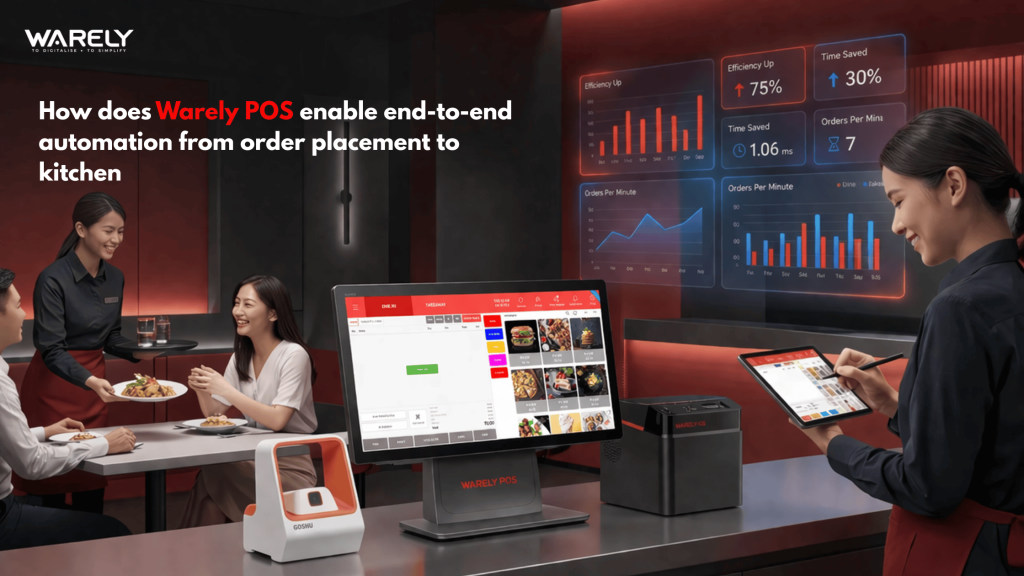
A busy Saturday service can quickly spiral into chaos without the right systems in place. This article explores how Warely POS enables true end-to-end automation—from order placement to kitchen execution and inventory updates—helping restaurants eliminate manual errors, reduce delays, and operate efficiently even during peak hours.
Contents

CEO, Warely
Read »
How System Freezes Create Long Queues — How Warely POS Ensures Uninterrupted Orders
How Menu Modifier Errors Happen During Peak Hours | How Warely POS Prevents Them
It was a Saturday evening at a mid-sized café in Tanjong Pagar. The dining room was full. Two servers had called in sick. The kitchen printer jammed mid-service, and three tables were waiting on orders that never made it through. By the time the manager realized what happened, a family of four had already walked out — and left a one-star review on Google by the time they reached their car.
This isn’t an unusual story in Singapore’s F&B scene. It’s Tuesday for most restaurant owners.
The gap between a customer placing an order and that order actually reaching the kitchen — correctly, completely, and on time — is where restaurants bleed money, reputation, and staff morale. And when you layer in manual inventory tracking on top of that, you’re essentially running a modern business on paper-era processes.
That’s exactly the problem the best POS system for restaurants needs to solve. Not just process payments, but orchestrate the entire operational flow from the moment a guest orders to the moment stock levels update in the background.
Warely POS was built with that end-to-end thinking at its core.
The Real Cost of Disconnected Operations
Let’s talk numbers — not inflated, just honest.
A restaurant operating without integrated systems typically faces:
- 8–12 minutes of delay per table during peak hours due to verbal order relay or manual ticketing
- 15–20% food waste from inaccurate inventory counts leading to over-ordering
- 3–5 billing errors per shift from manual order entry or miscommunication between floor and counter staff
- Staff spending upwards of 45 minutes per day reconciling inventory manually instead of serving guests
Multiply that across a week, a month, a year — and you’re looking at thousands of dollars in preventable loss, plus a team that’s constantly firefighting instead of hospitality-focused.
The challenge isn’t that restaurant owners don’t care. It’s that the tools they’ve been given weren’t designed to talk to each other.
What End-to-End Automation Actually Means
Here’s where it’s worth being precise, because “automation” is thrown around loosely in the software space.
True end-to-end automation in a restaurant context means:
- Order placement (dine-in, takeaway, or delivery) is captured through a single interface
- That order is instantly routed to the right kitchen station — grill, cold prep, drinks — without any manual relay
- Kitchen staff see orders on a Kitchen Display System (KDS) in real time, with timing and priority built in
- Once an order is fulfilled, inventory levels update automatically — ingredients deducted based on pre-set recipes
- At closing, reports are generated without anyone manually tallying sales, voids, or stock movements
Warely POS handles all five stages as a connected workflow, not five separate systems duct-taped together.
How Warely Handles the Kitchen Execution Layer
One of the most underappreciated parts of restaurant operations is the kitchen-floor communication gap. A server takes an order. They either shout it, write it down, or punch it into a terminal. Somewhere in that chain, details get lost — a modifier missed, a dietary restriction skipped, a course fired too early.
Warely’s order routing logic addresses this directly. When a server inputs an order — whether tableside via tablet or at a counter terminal — the system parses the order and sends each component to the correct kitchen station via the KDS. No printer jams. No lost tickets. Modifiers and special instructions appear alongside the order, not as an afterthought.
For multi-station kitchens, this matters enormously. A single table’s order might involve the grill station, the pasta station, and the bar — all of which need to time their execution so food arrives together. Warely’s KDS supports course-based firing, meaning the kitchen doesn’t start on mains until the system signals that starters are being served.
This kind of sequencing used to require an experienced expeditor standing at the pass. Now it’s built into the workflow.
Inventory That Updates Itself
The second major operational win is on the inventory management software side.
Most restaurants track inventory one of three ways: daily manual counts, weekly stock-takes, or pure gut feel. None of these are reliable at scale, and all of them introduce lag — meaning you often only discover you’re out of something when a customer orders it.
Warely’s inventory module works from a recipe-level logic. Every menu item is mapped to its components and quantities. When an order is placed and fulfilled, those quantities are automatically deducted from live stock counts. So if your laksa uses 200ml of coconut milk and you sell 40 bowls on a Friday night, the system knows you’ve used 8 litres — without anyone counting a single carton.
Low-stock alerts trigger automatically based on thresholds you set. This means your purchasing manager gets notified before you run out, not after.
What makes this genuinely useful — rather than just technically impressive — is the reporting layer. You can see which items are moving fast, which are sitting, and where your food cost percentage is drifting. That’s the kind of data that used to require a consultant or an accountant. Now it’s in your dashboard by morning.
The Peak-Hour Stress Test
Singapore’s F&B operators deal with some of the most compressed peak windows in the region. Lunch at a CBD restaurant might mean 200 covers in 90 minutes. If your system slows down, hesitates, or requires manual workarounds at 12:15pm, you’ve already lost.
Cloud-based POS solutions like Warely are designed specifically for this — operating on cloud infrastructure means your system doesn’t depend on a single local server that can overheat, crash, or lose data mid-service. Orders sync across terminals in real time. If one device drops off, the others keep running.
Staff adoption also matters here. Warely’s interface is designed to be intuitive enough that a new hire can process orders confidently within a few hours — reducing the training burden that plagues high-turnover F&B environments.
Why This Matters for Singapore F&B Operators Specifically
Singapore’s restaurant industry operates on tight margins — rental costs alone can consume 20–30% of revenue in prime locations. Labour costs are rising. Customer expectations around speed and accuracy are, frankly, unforgiving.
In that environment, operational inefficiency isn’t just inconvenient — it’s a structural threat to the business.
Warely POS doesn’t promise to replace good food or good hospitality. What it does is remove the operational friction that prevents your team from delivering both consistently. The kitchen gets clear, accurate orders. The floor team spends less time running back and forth. The owner walks in the next morning to clean reports instead of chaos.
That Saturday in Tanjong Pagar? With an integrated POS routing orders directly to a KDS, that kitchen printer jam never happens.The orders are displayed on the screen already. The family stays. The review doesn’t get written.
Warely POS is built for F&B operators who take their back-of-house as seriously as their front. If you’re evaluating systems, start with the workflow — not the features list.
Looking for a complete POS solution?

Related Blogs

 Riya
Riya Read >>
 Riya
Riya Read >>
 Riya
Riya Read >>

31 Woodlands Cl,
#08-04, Woodlands Horizon,
Singapore 737855
Newsletter

Solutions
Company
Insights

 From Singapore