
pos
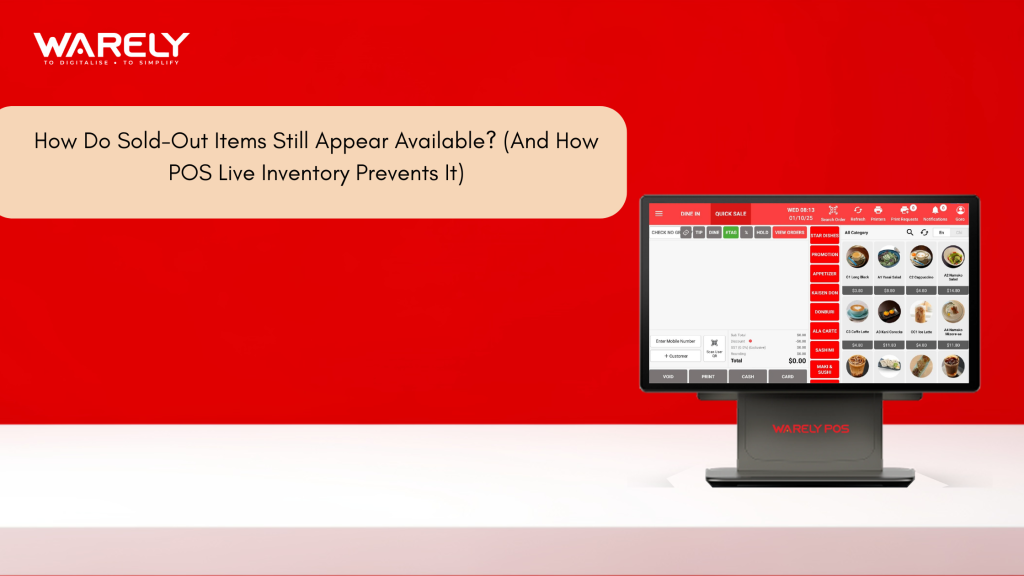
How Do Sold-Out Items Still Appear Available? (And How POS Live Inventory Prevents It)
Sold-out items showing as available is a common retail issue caused by delayed inventory updates. This guide explains ghost inventory, the risks of overselling, and how POS live inventory systems like Warely POS sync stock in real time to protect revenue and customer trust.
Contents

CEO, Warely
Read »
The High Cost of Disconnected Tools and How a Unified POS Solves It
How Costs from Limited POS Support Hurt Your Business—and How Warely’s 24/7 Support Eliminates Them
Sold-out items often appear available online due to “data latency”—a delay between the physical sale and the digital inventory update. This disconnect occurs when businesses use separate systems for in-store and online sales that rely on manual updates or slow batch syncing. POS live inventory prevents this by centralizing stock data in the cloud, ensuring that every barcode scan at the register instantly deducts quantity from the e-commerce platform in real-time, eliminating the risk of overselling.
Introduction: The “Ghost Inventory” Frustration
We have all been there. You find the perfect item online, add it to your cart, and successfully check out. But hours later, you receive an apology email stating the item is out of stock and your order has been cancelled. This phenomenon, known as “ghost inventory,” is a major friction point in modern retail. It damages brand reputation and frustrates customers who may never return. For business owners, it represents a fundamental disconnect between physical operations and digital storefronts. Understanding why this happens—and how to fix it—is the first step toward retail operational excellence.
The Technical Glitch: Why “Sold Out” Doesn’t Mean “Offline”
The primary reason an item shows as available when it is actually gone is inventory fragmentation. In many retail setups, the brick-and-mortar Point of Sale (POS) and the e-commerce website operate on two separate databases.
- Manual Reconciliation: Staff may sell the last unit in-store but fail to manually update the website until the end of the day.
- Batch Processing: Some older systems sync data only once every hour. If an online shopper buys an item at 2:15 PM that a walk-in customer bought at 2:10 PM, the system fails to catch the conflict.
- Caching Issues: Occasionally, a customer’s browser loads an older version of the product page where the “Buy” button is still active, bypassing the backend check.
What is POS Live Inventory?
Point of Sale (POS) Live Inventory is the technological bridge that solves fragmentation. Instead of maintaining two separate ledgers—one for the shop floor and one for the web—a live inventory system utilizes a single, centralized cloud database.
When a cashier scans a product, the system does not just record a transaction; it sends an immediate signal to the central database to reduce the stock count by one. Because the website reads from this exact same database, the online quantity is updated instantly. This unification transforms inventory from a static list into a dynamic, living stream of data.
The Mechanism: How Real-Time Syncing Works
To understand the depth of this solution, we must look at the mechanism. True live inventory relies on API Webhooks rather than scheduled updates.
- The Trigger: A transaction is finalized at the physical counter.
- The Signal: The POS triggers a webhook—an automated message sent to the server.
- The Update: The server instantly adjusts the “Available Quantity” across all connected channels (website, mobile app, food delivery platforms).
- The Result: If the quantity hits zero, the website automatically disables the “Add to Cart” button or switches the status to “Notify Me,” preventing the ghost order before it happens.
The Business Risk of “Overselling”
Ignoring this issue carries a heavy cost beyond just a refunded transaction.
- Operational Waste: Your team spends time processing an order, discovering the error, contacting the customer, and processing a refund. This is paid time spent on zero revenue.
- Platform Penalties: For merchants selling on marketplaces like Shopee, Lazada, or food delivery apps, frequent cancellations due to “out of stock” errors can lower your seller rating and reduce visibility.
- Customer Trust: In the age of instant gratification, reliability is a currency. A customer disappointed once rarely offers a second chance.
Warely POS: A Specialized Solution for Singapore
In the competitive landscape of retail technology, Warely POS has distinguished itself by focusing specifically on the needs of Singaporean SMEs. Led by industry veterans, Warely addresses local pain points such as high rental costs (requiring faster turnover) and manpower shortages (requiring automation).
Warely features designed to stop overselling:
- Unified Dashboard: Syncs offline sales, online webstore orders, and food delivery platform orders in one place.
- Low-Stock Triggers: Alerts management when stock is critical, allowing for faster reordering or marking items as “limited availability” to create urgency.
- Mobile Oversight: Business owners can view live inventory counts from their smartphones, ensuring they are never in the dark about what is actually on the shelf.
Real Customer Success Stories
The effectiveness of live inventory is best illustrated through real-world application. Warely has empowered over 1,000 businesses to streamline their operations.
- The F&B Transformation: A bustling café in the CBD struggled with lunch hour chaos. Online pickup orders were coming in for pastries that walk-in customers had just bought. By implementing Warely’s Kitchen Display System and live inventory sync, they reduced order rejections by 95%. This reliability led to a 30% increase in repeat corporate orders.
Get Up to 50% Off with Singapore’s PSG Grant!
Transitioning to a high-tech system is often perceived as expensive, but for Singaporean businesses, the barrier to entry is significantly lowered by the Productivity Solutions Grant (PSG).
Warely POS is a PSG Pre-Approved Vendor.
- The Financial Boost: Eligible SMEs can receive up to 50% funding support for qualifying POS packages.
- Eligibility Criteria:
- Business must be registered and operating in Singapore.
- The solution must be used within Singapore.
- The business must have a minimum of 30% local shareholding.
- Application Process: Simply obtain a quotation from a pre-approved vendor like Warely, apply via the Business Grants Portal (BGP), and once approved, purchase the system to claim the reimbursement.
Why Credibility Matters When Choosing a POS
When you choose a POS system, you’re not just buying software—you’re selecting a long-term partner for your business’s financial operations.
- Built for real operations: The right POS is developed by teams who deeply understand retail and F&B workflows, not just technical code. This ensures smoother billing, inventory control, and day-to-day operations.
- Proven and vetted: Systems that receive government pre-approval, such as through the PSG grant, are evaluated by agencies like IMDA for technical capability, reliability, and financial stability.
- Secure and dependable: A POS manages sensitive customer data and payment transactions. Choosing a compliant and widely recognized system reduces the risk of security breaches, data loss, and regulatory exposure.
Conclusion: The Future is Real-Time
The days of manual spreadsheets and “checking the back” are over. In a digital-first economy, inventory visibility must be instantaneous. When sold-out items appear available, it is not just a technical error; it is a broken promise to a customer. By adopting a robust solution like Warely POS, businesses can eliminate ghost inventory, automate their operations, and secure customer loyalty. With the PSG Grant absorbing up to 50% of the cost, there has never been a better time to upgrade your infrastructure and stop selling what you don’t have.
Looking for a complete POS solution?

Related Blogs

 Riya
Riya Read >>
 Riya
Riya Read >>
 Riya
Riya Read >>

31 Woodlands Cl,
#08-04, Woodlands Horizon,
Singapore 737855
Newsletter

Solutions
Company
Insights

 From Singapore