
pos
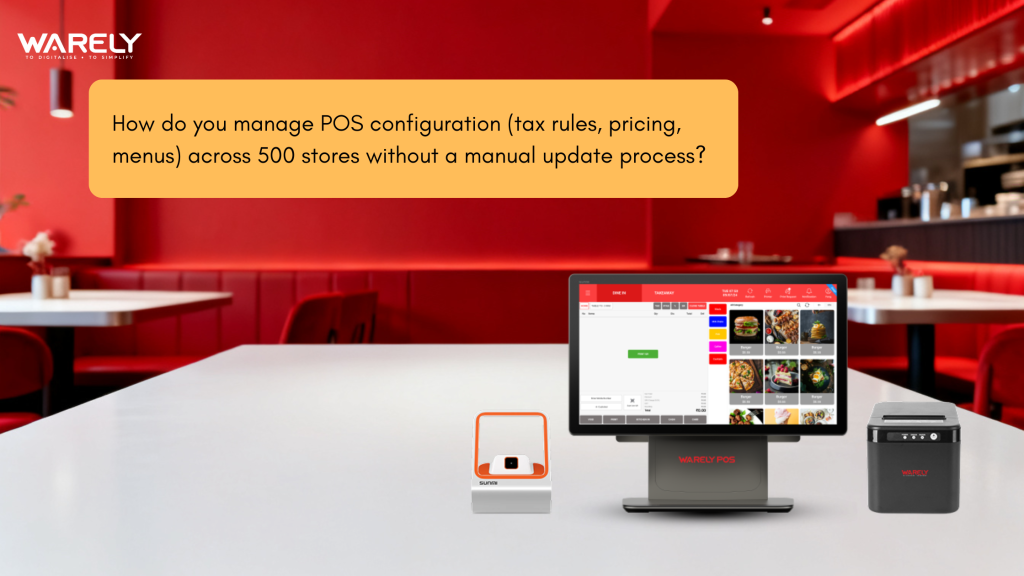
How do you manage POS configuration (tax rules, pricing, menus) across 500 stores without a manual update process?
Managing POS configuration across hundreds of outlets is one of the biggest operational challenges in the F&B industry. From tax compliance to pricing consistency and menu updates, manual processes quickly become inefficient and error-prone at scale. This article explores how centralized, cloud-based POS systems eliminate these challenges, improve accuracy, and ensure seamless operations across large restaurant networks.
Contents

CEO, Warely
Read »
How a POS System Helps Cashiers Stay Calm During Busy Hours | Warely POS Singapore
How Limited POS Features Are Quietly Killing Your Restaurant’s Growth
Picture this: It’s 11:45 on a Friday morning at a popular hawker-style chain in Singapore. The lunch crowd is already queuing. A new GST-adjusted pricing rule was supposed to go live across all 500 outlets at 11:00 AM. But three stores in Jurong are still charging the old rate. Two outlets near Orchard Road haven’t received the updated menu. And your operations manager? He’s fielding calls from six different store managers simultaneously.
This isn’t a hypothetical. It’s a reality that multi-location F&B operators in Singapore face more often than they’d like to admit.
Managing POS configuration across a large restaurant network — tax rules, pricing tiers, promotional menus — is one of the most underestimated operational challenges in the industry. And if your current process involves spreadsheets, WhatsApp groups, or manual store visits, you already know the pain.
Why Manual POS Updates Break Down at Scale
Let’s be direct about something: a process that works for five stores will fail spectacularly at fifty, and become genuinely dangerous at five hundred.
Here’s where things typically collapse:
- Tax rule mismatches — Singapore’s GST compliance requires precision. One store charging 8% while another charges 9% isn’t just a revenue leak; it’s a regulatory liability.
- Menu inconsistency — A seasonal promo runs in 400 outlets but missed 100 because someone forgot to update the config file.
- Peak-hour billing errors — Staff at high-traffic outlets skip verification steps during rush periods. Wrong pricing gets processed. Customers get frustrated. Refunds eat into margins.
- Staff dependency — When the one person who “knows how the POS works” calls in sick, updates get delayed by days.
A mid-sized F&B chain with 50 outlets can spend upwards of 15–20 man-hours per week just managing POS configuration. Scale that to 500 stores, and you’re looking at a full-time team doing nothing but pushing updates — and still making errors.
The Real Cost Nobody Talks About
Operational leaders tend to track food cost and labour cost. Few measure configuration error cost — but it adds up fast.
Consider: if even 2% of daily transactions across 500 outlets carry a pricing error averaging SGD 1.50, that’s potentially SGD 15,000 in daily discrepancies. Over a month, that’s real money, real compliance risk, and real customer trust erosion.
This is precisely why choosing the best POS system for restaurants isn’t just a technology decision — it’s a business continuity decision.
What Centralised POS Management Actually Looks Like
The shift from manual to centralised configuration isn’t just about convenience. It’s about removing human error from the equation entirely.
With a cloud-based architecture, configuration changes — tax updates, price adjustments, menu swaps — are pushed from a single dashboard to every connected terminal simultaneously. No USB drives. No remote desktop sessions. No calling each store individually.
Warely POS is built specifically for this. Its centralised management console allows operators to:
- Set tax rules once, deploy everywhere — GST changes, service charge adjustments, or dine-in vs. takeaway tax differentiation can be configured at the headquarters level and pushed across all 500 stores in minutes.
- Schedule menu updates in advance — A weekend brunch menu or a National Day promotion can be programmed to activate at a precise time, with zero manual intervention on the day.
- Control pricing by zone or outlet group — Orchard Road stores might carry different pricing from heartland outlets. Warely’s configuration supports outlet-level customisation without sacrificing central oversight.
This is what modern cloud-based POS solutions actually deliver — not just digital billing, but operational intelligence.
Inventory Follows Configuration
Here’s something operators often overlook: your POS configuration and your inventory management software need to speak the same language.
When a menu item is added to the POS, the ingredient-level inventory deduction should update automatically. When a product is 86’d at a specific outlet, the POS should reflect that in real time. Manual disconnects between these two systems cause overselling, stockouts, and — worst of all — customer-facing failures during peak hours.
Warely integrates both functions, meaning a centralised menu update also triggers the corresponding inventory logic. One action, cascading accuracy.
What Implementation Actually Requires
Deploying centralised POS management across 500 stores sounds complex. In practice, the heavy lifting is upfront:
- Audit existing configurations across all outlets
- Standardise naming conventions for items, tax codes, and outlet groups
- Map out override rules (which stores need custom configurations)
- Train a small central team, not 500 individual store staff
Once the framework is in place, ongoing management becomes genuinely lightweight. Most operators report that what used to take a team of five now requires one person, part-time.
The Compliance Angle Singaporean Operators Can’t Ignore
Singapore’s IRAS doesn’t offer flexibility on GST reporting errors. When your POS data feeds directly into your accounting and tax reporting, configuration accuracy isn’t optional — it’s statutory.
A centralised system creates an auditable trail. Every configuration change is logged, timestamped, and attributable. That’s the kind of documentation that protects you during an IRAS audit and gives your finance team clean data to work with.
Signs You’ve Outgrown Your Current System
If any of these sound familiar, the problem isn’t your team — it’s your infrastructure:
- Price changes require coordination across multiple people and systems
- You’ve had customer complaints about inconsistent pricing between outlets
- A new menu launch created confusion at the store level
- Your IT team is involved in routine pricing updates
Conclusion: Scale Demands Systems, Not Spreadsheets
Running 500 stores with manual POS updates is like navigating a city with a printed map from five years ago. The city has changed. The tools need to match the scale.
Centralised, cloud-based POS management isn’t a luxury for enterprise F&B operators in Singapore — it’s the foundation that everything else is built on. Pricing accuracy, tax compliance, operational efficiency, and customer experience all depend on getting this right.
If your current process involves more people than it should, more errors than you can afford, and more time than the problem deserves — it’s worth looking seriously at what Warely POS can do for your network.
Because at 500 stores, the margin for manual error is zero.
Looking for a complete POS solution?

Related Blogs

 Riya
Riya Read >>
 Riya
Riya Read >>
 Riya
Riya Read >>

31 Woodlands Cl,
#08-04, Woodlands Horizon,
Singapore 737855
Newsletter

Solutions
Company
Insights

 From Singapore