
pos
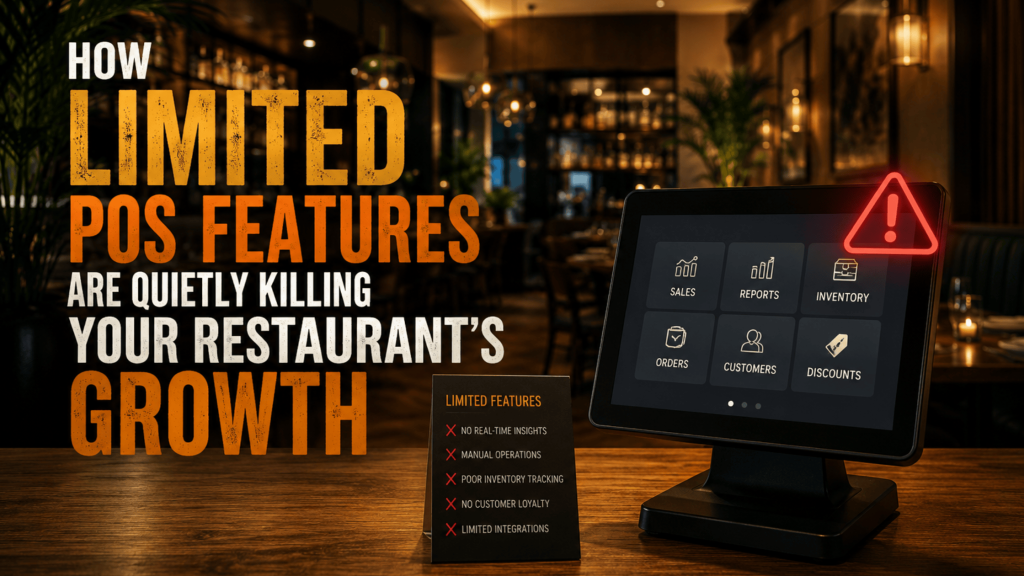
How Limited POS Features Are Quietly Killing Your Restaurant's Growth
This article explores how limited POS systems negatively impact restaurant operations in Singapore’s competitive F&B industry. From peak-hour delays and billing errors to inventory shortages and poor reporting, outdated systems create hidden operational costs that affect profitability and customer experience. The article explains how modern cloud-based solutions like Warely POS help restaurants streamline operations with real-time inventory tracking, kitchen display integration, smart analytics, multi-payment support, and scalable multi-outlet management.
Contents

CEO, Warely
Read »
It’s a Friday evening at a popular hawker-style café in Tanjong Pagar. Tables are full, the kitchen is backed up, and your one cashier is manually keying in orders while juggling a queue of impatient customers. The system freezes. The receipt printer jams. A table asks to split the bill three ways. And somewhere in the back, a staff member is trying to figure out why the char kway teow station ran out of eggs — again.
Sound familiar?
This isn’t a staffing problem. It’s a systems problem. And across Singapore’s F&B industry, it’s playing out in restaurants, bubble tea shops, and food courts every single day.
The Real Cost of a Basic POS System
Most business owners buy a POS system thinking it just needs to process payments. That belief is expensive.
A limited POS doesn’t just slow down checkout — it creates a chain reaction of inefficiencies that eat into your margins, frustrate your staff, and push customers toward competitors who offer a smoother experience.
Here’s what that actually looks like in practice:
- Peak-hour bottlenecks — When your POS can’t handle table splitting, modifiers, or concurrent orders, your cashier becomes the bottleneck. A single stuck transaction during dinner rush can delay 4–6 tables.
- Manual billing errors — Staff manually keying in prices or calculating discounts introduces human error. Even one wrong bill per shift, at an average order value of SGD 35–45, compounds into thousands in losses or disputes monthly.
- No real-time inventory visibility — Running out of a menu item mid-service isn’t just an inconvenience. It breaks customer trust. Without live stock tracking, your team is guessing until someone physically checks the storeroom.
- Staff training drag — A clunky, unintuitive interface means new hires take longer to get comfortable on the floor. In an industry already dealing with high turnover, that’s a recurring cost.
Singapore’s F&B sector operates on notoriously tight margins — often between 5% and 15%. When your POS is creating friction at multiple touchpoints, those margins shrink faster than they should.
What “Limited Features” Actually Means Day-to-Day
There’s a difference between a POS that takes orders and one that runs your business.
A restaurant owner in Bukit Timah once described her old system like this: “It was like running a modern restaurant with a 2012 tool. Everything was manual — end-of-day reports, inventory counts, promo tracking. I was spending two hours after closing just reconciling what the machine couldn’t do automatically.”
That’s two hours every night. Roughly 60 hours a month. Time that could be spent on menu development, staff coaching, or simply resting.
The operational gaps that matter most include:
- No integration between front-of-house and kitchen When orders aren’t automatically sent to the kitchen display, miscommunication increases. Wrong dishes go out. Tables wait longer. Kitchen staff work reactively instead of efficiently.
- Absence of sales analytics Without data on your top-selling items, peak hours, or table turnover rates, you’re making menu and staffing decisions based on gut feel. That works until it doesn’t.
- No support for multi-payment methods Singaporean consumers expect PayNow, GrabPay, credit cards, and NETS — sometimes in a single transaction. A POS that struggles here creates friction at the worst possible moment: checkout.
- Weak inventory management If your system isn’t connected to an inventory management software that auto-deducts stock with each sale, you’re manually counting ingredients and hoping for the best. That’s not sustainable during high-volume periods.
What a Capable POS Actually Changes
This is where the conversation shifts from problem to solution.
The best POS system for restaurants doesn’t just process transactions — it becomes the operating backbone of your business. When the right system is in place, the difference is felt almost immediately.
With Warely POS, Singapore F&B operators get a system designed around actual restaurant workflows — not a generic retail tool retrofitted for food service. Here’s what that looks like practically:
- Kitchen Display System (KDS) integration — Orders flow directly from the table to the kitchen the moment they’re placed. No paper tickets. No shouting across the pass.
- Real-time inventory deductions — Every sale automatically updates your stock levels, so you’re never caught off guard mid-service.
- Smart reporting dashboard — Know your best-selling items, your slowest hours, and your top-performing staff — all from one screen, updated live.
- Multi-outlet management — Running more than one location? Warely lets you monitor all outlets from a single dashboard, which is critical as you scale.
- Staff access controls — Assign different permission levels so managers and cashiers only see what’s relevant to their role. Reduces errors and improves accountability.
These aren’t luxury features. They’re operational necessities for any F&B business serious about growth.
The Scalability Question
Here’s something most POS vendors won’t tell you upfront: the system that works for your first outlet will likely fail you at your third.
Scalability isn’t just about capacity — it’s about consistency. Can your POS replicate the same workflows, reporting, and customer experience across multiple locations? Can it handle a loyalty program, a delivery integration, and a dine-in queue simultaneously?
Cloud-based POS solutions like Warely are built with this in mind. Your data lives in the cloud, accessible from anywhere, updated in real time. If your internet drops, offline mode keeps transactions running. When it reconnects, everything syncs automatically.
This matters enormously in Singapore, where leases are expensive, competition is intense, and the window for a struggling outlet to turn profitable is narrow.
Final Thought
A POS system is not a commodity purchase. It’s an infrastructure decision.
Every day you operate with a system that can’t keep up, you’re absorbing hidden costs — in staff time, in errors, in missed data, and in customer experience. The numbers aren’t always visible on a P&L, but they show up in your margins over time.
Warely POS was built specifically for F&B operators who are done patching over the gaps. If your current system is slowing you down, it might be worth asking — not whether you can afford to upgrade, but whether you can afford not to.
Ready to see how Warely fits your operation? Explore how modern cloud-based POS solutions are helping Singapore restaurants run leaner, faster, and smarter.
Looking for a complete POS solution?

Related Blogs

 Riya
Riya Read >>
 Riya
Riya Read >>
 Riya
Riya Read >>

31 Woodlands Cl,
#08-04, Woodlands Horizon,
Singapore 737855
Newsletter

Solutions
Company
Insights

 From Singapore