
pos
Stop Losing Margins: How Interchange Fees Become a Hidden Tax on Every Swipe And How Does Warely POS Fix It?
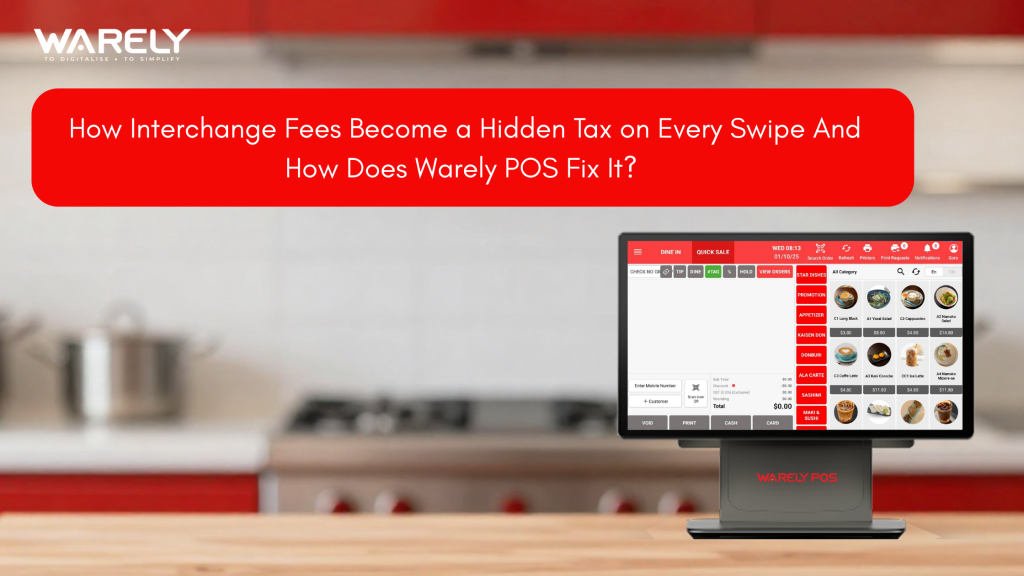
Interchange fees quietly drain 1%–3% of merchant revenue on every card swipe, acting like a hidden tax on business growth. This in-depth guide explains how interchange fees work, why they hurt margins, and how Warely POS minimizes payment costs through integrated payments, transparent pricing, and alternative low-fee methods like PayNow and QR. Backed by Singapore’s PSG Grant with up to 50% funding support, Warely POS helps retailers modernize their checkout, reduce errors, and protect long-term profitability.
Contents

CEO, Warely
Read »
How a Confusing POS System Hurts Your Restaurant’s Professional Image | Warely POS Singapore
Simplify Bill Splitting and Boost Restaurant Efficiency with Warely POS
Every time you hear that reassuring beep of a credit card transaction, two things happen. First, you made a sale—congratulations. Second, a silent hand reaches into your cash register and takes a slice of your revenue.
For many merchants in Singapore and beyond, credit card processing fees are just “the cost of doing business.” But when you dig deeper, these fees—specifically interchange fees—act like a hidden tax on your growth. They punish you for being successful.
If you are tired of losing 1% to 3% of your gross revenue to invisible middlemen, you need to understand the mechanics of the swipe. More importantly, you need a Point of Sale (POS) system that fights back. Here is the deep dive into the economics of payments and how Warely POS, backed by Singapore’s PSG Grant, is changing the equation for retailers.
What Are Interchange Fees, Really?
Interchange fees are the transaction fees that the merchant’s bank (the acquiring bank) pays to the customer’s bank (the issuing bank) whenever a customer uses a credit or debit card.
While you might see a single “Merchant Discount Rate” (MDR) on your statement, that rate is a bundle of three distinct costs:
- Interchange Fee: Goes to the cardholder’s bank (the biggest chunk).
- The evaluation: fee is paid to the card network.
- Payment Processor Markup: The fee your provider charges for facilitating the deal.
think of interchange fees as the “wholesale price” of processing a payment. It is a non-negotiable base rate set by the card networks, but how it is packaged and sold to you creates the hidden tax.
The Economics of the Swipe: Where Does Your Money Go?
When a customer buys a $100 dress, you don’t get $100.
- Data Capture: Your terminal sends card data to the processor.
- Authorization: The processor asks the issuing bank if funds exist.
- Settlement: The money moves.
In this split second, the “tax” is applied. If your effective rate is 2.5%, you only receive $97.50. That $2.50 vanishes. It funds the customer’s airline miles, the bank’s fraud protection, and the network’s infrastructure. While these are necessary services, the opacity of these fees allows inefficient processors to hide excessive markups behind the confusing label of “interchange.”
Why Interchange Fees Are a “Hidden Tax”
We call this a “tax” because it scales linearly with your revenue but offers no additional value to your operation beyond the transaction itself. Unlike rent or software subscriptions, which are fixed costs, interchange fees punish volume.
- Premium Card Penalty: If your customer uses a “Platinum Rewards” card, the interchange fee is higher. You are literally paying for their rewards points.
- Card-Not-Present Risk: If you manually key in a number because your terminal is glitchy, the fee jumps significantly due to higher fraud risk.
- Opaque Statements: Most merchant statements are designed to be confusing, lumping various fees together so you cannot see where the “tax” ends and the service fee begins.
The Merchant’s Dilemma: Absorb or Pass On?
Merchants usually face a difficult choice regarding these fees:
- Absorb the Cost: This eats directly into net profit margins.A 2.5% processing fee effectively snatches 25% of your profit if your company has a 10% net margin.
- Pass it On (Surcharging): You can charge customers extra for using cards. However, this creates friction, damages customer loyalty, and can look unprofessional compared to competitors.
Neither option is ideal. The third option is optimization—using technology to lower the cost of acceptance.
Warely POS: The Efficiency Engine
Warely POS is not just a digital cash register; it is a unified commerce ecosystem designed to minimize operational friction and financial leakage. Warely approaches the “hidden tax” problem by integrating payments directly into the operational workflow, reducing errors, and partnering with transparent payment providers.
Warely moves beyond the standard transactional relationship. By centralizing inventory, customer data, and payments, it provides the leverage needed to streamline costs.
How Warely Reduces the Pain of Payment Processing
Warely mitigates the impact of interchange fees through Integrated Payments Architecture.
- Elimination of Key-In Errors: Non-integrated terminals require cashiers to type amounts manually. If they make a mistake or force a transaction type that carries higher risk, fees skyrocket. Warely pushes the exact transaction amount directly to the terminal, ensuring the transaction qualifies for the lowest possible interchange category.
- Preferred Payment Partners: Warely integrates with modern payment gateways that offer transparent “Interchange-Plus” pricing. This transparency ensures you pay the true wholesale cost plus a small margin, rather than a flat, inflated rate that hides the processor’s profit.
- Alternative Payment Methods: Warely seamlessly handles lower-cost payment methods prevalent in Singapore, such as PayNow and QR payments, encouraging customers to use methods that carry significantly lower fees than premium credit cards.
The Financial Game-Changer: Singapore’s PSG Grant
This is where the ROI of Warely becomes undeniable. Warely POS is a pre-approved solution under Singapore’s Productivity Solutions Grant (PSG).
The PSG is an initiative by the Singapore government to help local businesses kick-start their technology journey.
- The Offer: Eligible SMEs can receive up to 50% funding support for the adoption of Warely POS.
- The Impact: This grant effectively slashes the barrier to entry. You aren’t just getting a discount on software; you are getting a government-subsidized upgrade to your financial infrastructure.
- Long-term Savings: By using the grant to subsidize the setup of a more efficient system, the capital you save can be used to buffer against transaction fees while your volume grows.
Real Customer Success Stories
Trust is built on results. Here is how real businesses are utilizing the Warely ecosystem to stabilize their bottom line.
The High-Volume F&B Outlet
The Challenge: A busy cafe faced “line abandonment” during lunch rushes. Their slow, non-integrated card terminals were causing delays, and manual entry errors were resulting in “downgraded” transactions (higher fees).
The Warely pos Solution: Warely’s rapid-fire transaction mode and direct terminal integration sped up the checkout process by 40%.
The Outcome: Faster turnover meant more sales. The reduction in manual entry errors lowered their effective payment processing rate by roughly 0.3%—a massive saving on high annual volume.
Built on Security, Compliance, and Local Expertise
- In retail technology, reliability and trust are non-negotiable. Warely is designed with strong compliance standards and a deep understanding of local business requirements, so merchants can operate with confidence.
- Secure Transactions: Warely is fully PCI-DSS compliant, ensuring every card transaction is protected with industry-grade security—so reducing costs never comes at the expense of customer data safety.
- Singapore-Focused Support: Unlike generic global POS systems, Warely is built for the Singapore market. From understanding local retail workflows to guiding merchants through PSG Grant eligibility, Warely delivers support that aligns with real, on-ground business needs.
Conclusion: Stop Paying the Tax, Start Optimizing
Interchange fees will likely never disappear entirely—they are the fuel of the global banking system. However, accepting them as a “hidden tax” that you cannot control is a mistake.
The combination of opaque pricing and inefficient technology bleeds your profit margins dry. You can stop the bleeding by choosing a POS that offers integrated payments, transparent partner pricing, and operational speed.
With Warely POS, you don’t just get a software solution; you get a financial ally. And with the ability to get up to 50% off via Singapore’s PSG Grant, there has never been a better time to modernize your counter.
Looking for a complete POS solution?

Related Blogs

 Riya
Riya Read >>
 Riya
Riya Read >>
 Riya
Riya Read >>

31 Woodlands Cl,
#08-04, Woodlands Horizon,
Singapore 737855
Newsletter

Solutions
Company
Insights

 From Singapore