
pos
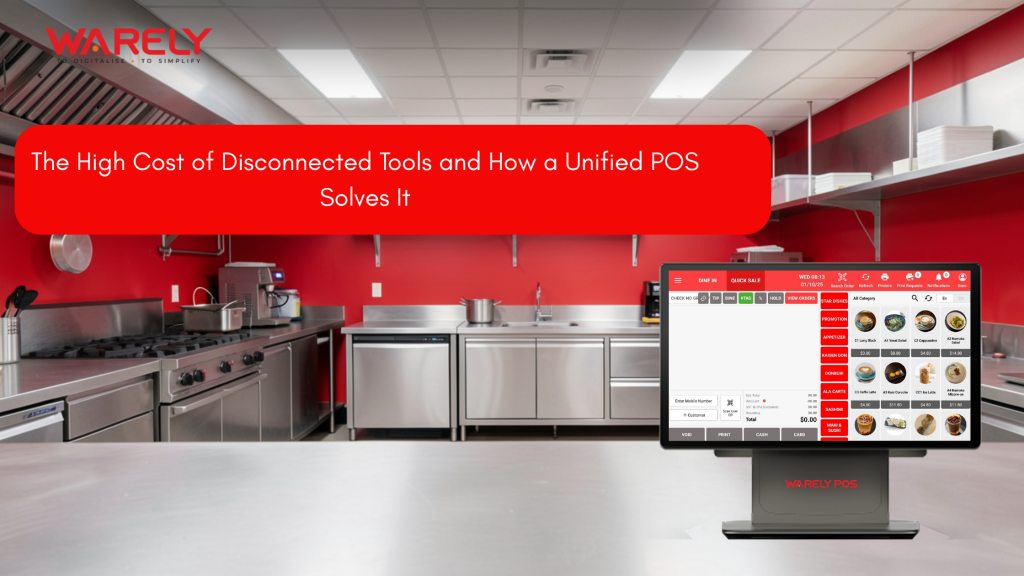
The High Cost of Disconnected Tools and How a Unified POS Solves It
This article explains how disconnected retail and restaurant tools create hidden operational costs, from inventory errors to accounting headaches. It shows how a unified POS system—like Warely POS—acts as a central hub to automate workflows, improve customer experience, and support scalable growth, with real-world examples and government grant benefits.
Contents

CEO, Warely
Read »
The High Cost of Disconnected Tools and How a Unified POS Solves It
How Costs from Limited POS Support Hurt Your Business—and How Warely’s 24/7 Support Eliminates Them
Introduction: The Trap of Too Many Tools
Many retail businesses start small, adding one software tool at a time. You might have one app for your online store, a different system for your physical cash register, and a spreadsheet for inventory. While each tool works fine on its own, they do not talk to each other. This creates a hidden trap for business owners. Instead of helping you grow, these disconnected tools create a web of manual work that slows you down. The solution lies in moving from separate apps to a single, unified Point of Sale (POS) system that acts as the brain of your business.
The High Cost of Manual Task Switching
The most obvious sign of disconnected tools is what industry experts call the “swivel chair” effect. This happens when a staff member has to look at one screen to see an online order, then physically turn to another screen to type that order into the accounting system.
This manual data entry is the biggest cause of retail errors. Every time a human has to copy numbers from one place to another, there is a risk of a mistake. If you process hundreds of transactions a day, even a small error rate adds up to huge losses over a year. A unified POS removes this step entirely by sending data automatically between systems.
Inventory Nightmares and “Ghost Stock”
When your in-store POS doesn’t communicate with your online ordering, you run into inventory desynchronization.
For example, a customer might dine in and order the last grilled chicken.
However, your online menu doesn’t know this happened.
Ten minutes later, an online customer orders that same grilled chicken because the menu says it is still available.
This creates “ghost stock”—menu items that don’t actually exist.You now have to cancel the online order, refund the customer, and apologize.
This damages your restaurant’s reputation.
A unified system updates inventory in real time, ensuring that what you see on the screen matches what the kitchen can serve.
The Accounting Reconciliation Headache
For many business owners, the end of the month is a stressful time. If your sales data sits in one app and your bank deposits sit in another, you have to spend hours matching them up manually. This is called reconciliation.
Disconnected tools force you or your accountant to use complex spreadsheets to verify that the money in the bank matches the sales record. This delay means you often don’t know your true profit until weeks after the month ends. A modern, integrated POS sends financial data directly to accounting platforms like Xero or QuickBooks, automating the process and giving you instant financial clarity.
A Fragmented Customer Experience
Today’s customers expect a smooth experience whether they are shopping on their phone or in your store. Disconnected tools break this experience. If a customer buys an item online but wants to return it in-store, a disconnected system often can’t handle it because the in-store register can’t “see” the online transaction.
Furthermore, loyalty programs often fail when tools aren’t linked. A customer might earn points for an online purchase but be told they cannot redeem them at the physical counter. This frustrates loyal shoppers. A unified pos system keeps one single profile for every customer, tracking their history and rewards across all channels.
How a Unified POS Integrates Everything
The answer to these problems is an “ecosystem” approach. A modern POS is not just a calculator with a cash drawer; it is a central hub. It uses technology to pull data from your eCommerce site, your payment terminal, and your inventory warehouse into one dashboard.
When a sale happens anywhere, the unified POS instantly deducts the item from inventory, records the revenue in your accounting ledger, and updates the customer’s purchase history. This creates a “single source of truth.” You no longer have to guess which system is correct because all systems are reading from the same data.
Real Customer Success Story: The Restaurant Turnaround
Consider a growing casual dining restaurant in Singapore operating two dine-in outlets and offering online orders through food delivery platforms. The team struggled with disconnected systems—orders came in from multiple channels, inventory was tracked manually, and end-of-day reconciliation took hours. Despite the effort, popular menu items often showed as “available” online even after they sold out in-store, leading to cancellations and unhappy customers.
They switched to a unified POS system that connected in-store orders, online platforms, and inventory in real time. The impact was immediate. Manual stock checks were eliminated, saving over 12 hours of staff time each week per outlet. Order errors and cancellations dropped to zero. With smoother operations and faster service, staff focused more on customers—driving a 20% increase in monthly revenue within six months.
Why Warely is the Ideal Solution for Growth
This is where Warely stands out in the market. Warely pos is designed specifically to solve the problem of disconnected tools. It is not just a POS; it is a retail operating system.
Warely pos offers deep integration capabilities, meaning it speaks the same language as the other tools you use. Whether it is syncing with food delivery platforms, managing complex retail inventory, or linking with accounting software, Warely pos automates the workflow. It eliminates the manual workarounds that exhaust your team, allowing you to run a multi-channel business from a single device.
Get Up to 50% Off with Singapore’s PSG Grant
Upgrading your technology can seem expensive, but for businesses in Singapore, there is significant financial help available. The Productivity Solutions Grant (PSG) is a government initiative designed to help companies modernize.
Because Warely is a pre-approved vendor for this grant, eligible Singaporean businesses can get up to 50% funding support when they adopt the system. This makes the switch to a unified POS incredibly affordable. The government effectively pays half the cost for you to stop doing manual data entry and start using professional, automated tools. It is a massive opportunity to increase your business valuation and operational efficiency at a fraction of the market price.
Conclusion: Stop Patching, Start Integrating
Manual workarounds are a ceiling on your business growth. You cannot scale a business if you are busy fixing spreadsheet errors or apologizing for out-of-stock items. The transition to a unified POS system removes these barriers.
By integrating your sales, inventory, and accounting into one system like Warely, you gain control over your operations. With the added benefit of the PSG Grant, there has never been a better time to make the switch. Stop letting disconnected tools dictate your schedule and start building a business that runs smoothly, accurately, and profitably.
Looking for a complete POS solution?

Related Blogs

 Riya
Riya Read >>
 Riya
Riya Read >>
 Riya
Riya Read >>

31 Woodlands Cl,
#08-04, Woodlands Horizon,
Singapore 737855
Newsletter

Solutions
Company
Insights

 From Singapore