
pos
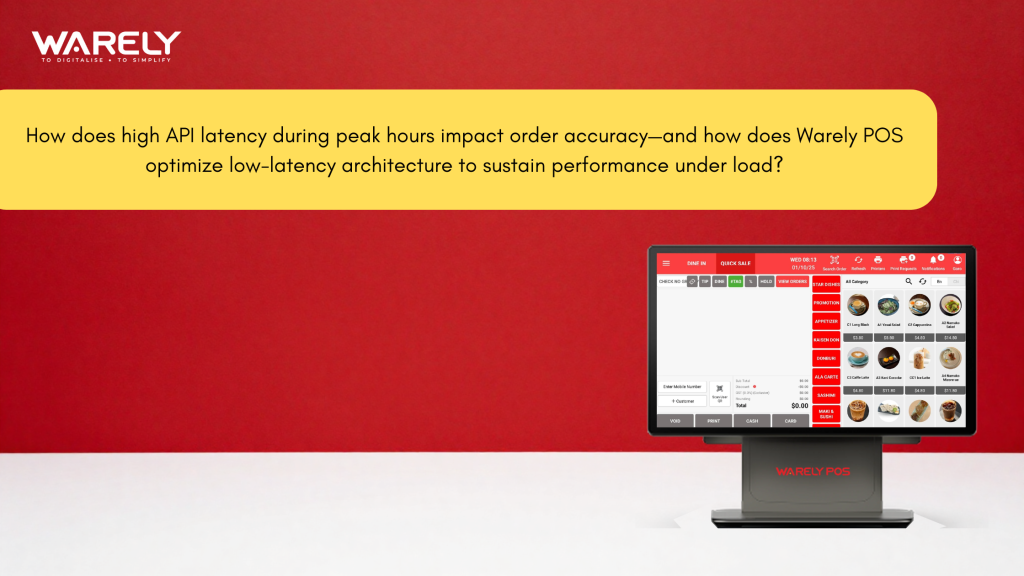
How does high API latency during peak hours impact order accuracy—and how does Warely POS optimize low-latency architecture to sustain performance under load?
High API latency during peak hours can silently damage your retail or F&B business. From duplicate charges and ghost orders to inventory mismatches and slow checkout queues, system lag directly impacts revenue and customer experience. Warely POS solves this challenge with a hybrid low-latency architecture that processes critical actions locally while optimizing cloud communication. With built-in offline capabilities and real-time synchronization, Warely ensures accurate transactions even under heavy load. Plus, Singapore businesses can upgrade affordably with up to 50% support through the Productivity Solutions Grant (PSG).
Contents

CEO, Warely
Read »
Why Sold-Out Items Still Show Available & How POS Live Inventory Fixes It
How Printer Errors Delay Checkout & How POS-Guided Setup Fixes It | Warely POS
1. Introduction: The Need for Speed in Modern Retail
Imagine a busy lunch hour where the line stretches out the door. Your staff is working hard, but the Point of Sale (POS) system is lagging. This delay, technically known as high API latency, is more than just an annoyance; it is a major cause of order errors.
When your system is slow to communicate with the server, orders get duplicated, inventory fails to update, and customers get frustrated. This article explains exactly how latency destroys accuracy and how Warely POS uses advanced low-latency architecture to keep your business running smoothly, even during the busiest peak hours. Plus, for businesses in Singapore, upgrading to this technology is more accessible than ever—Get up to 50% off with Singapore’s PSG Grant!
2. What is API Latency and Why Does It Spike?
API latency is the time it takes for your POS system to send a request to the server (like placing an order) and get a confirmation back. Think of it like a waiter walking to the kitchen. If the waiter is fast, the kitchen starts cooking immediately. If the waiter moves in slow motion, everything gets delayed.
During peak hours, thousands of transactions happen simultaneously. If a POS system relies entirely on a heavy, cloud-only infrastructure, the “digital traffic” clogs the network. This causes spikes in latency. Instead of an instant blink, the screen freezes for two or three seconds. In those few seconds, chaos happens.
3. The Hidden Cost: How Latency Kills Order Accuracy
High latency is the primary culprit behind “ghost orders” and double entries. Here is the direct answer to how it happens: when a cashier presses “Charge” and the system lags, they often assume the button didn’t work and press it again.
Because of the delay, the server eventually receives both clicks. The result? The customer is charged twice, or the kitchen receives two duplicate dockets for the same table. This confusion slows down the kitchen, creates food waste, and forces the front-of-house staff to spend valuable time fixing refunds instead of serving customers.
4. Data Desynchronization: When Inventory Lags Behind
One of the most dangerous side effects of high latency is inventory desynchronization. In a low-latency environment, when a customer buys the last chocolate cake, the system instantly updates the inventory to “0.”
However, with high latency, that update might take 30 seconds to reflect across all terminals. In that window, another waiter might sell that same cake to a different table. Now, you have sold one cake to two people. This forces your staff to have an awkward conversation with a customer, apologizing that the item they paid for actually doesn’t exist.
5. The “Spinning Wheel”: Impact on Checkout Speed and Experience
user experience, and in the real world, nothing ruins experience like a waiting line. High latency creates the “spinning wheel of death” on your screen.
If every transaction takes an extra five seconds to process due to lag, and you serve 100 customers during lunch, you have added over eight minutes of pure dead time to your queue. This impacts table turnover rates. Warely POS addresses this by ensuring that the interface remains responsive, keeping the line moving and the customers happy.
6. How Warely POS Optimizes Low-Latency Architecture
Warely POS solves the latency issue by not relying solely on heavy cloud traffic for every single micro-interaction. Instead, Warely utilizes a hybrid low-latency architecture.
This means the POS processes immediate data (like adding an item to the cart or calculating tax) locally on the device’s hardware. It optimizes the data packets sent to the server, making them “lighter” and faster to transmit. By reducing the reliance on a constant, heavy internet handshake for every button press, Warely ensures that the interface remains snappy and instant, regardless of how many people are using the system at once.
7. Offline Capabilities: The Ultimate Safety Net
To truly sustain performance under load, a system must be ready for the worst-case scenario: internet failure. High latency often precedes a total connection drop.
Warely POS includes robust offline capabilities. If the API latency becomes too high or the internet cuts out, Warely automatically switches to local processing. It stores all transaction data securely on the device. Once the connection stabilizes, it syncs everything to the cloud in the background. This ensures that order accuracy is never compromised by a poor internet connection.
8. Real Customer Success Story: The “Bistro Rush” Scenario
Consider the case of a popular bistro in the Central Business District (CBD). Before switching to Warely, they used a legacy cloud POS. During their 1:00 PM lunch rush, their old system would lag, leading to at least 3-4 voided orders daily due to double-entry errors.
After implementing Warely POS, the difference was immediate. The “Bistro Rush” scenario changed. Even with 50 orders coming in within 20 minutes, the terminals remained instant. The manager reported a 95% reduction in order errors in the first month. The staff no longer hesitated when pressing buttons, trusting the system to react instantly. This reliability allowed them to serve 15% more customers during their peak window.
9. The Financial Upside: Singapore’s PSG Grant
Investing in high-performance technology might seem expensive, but for Singapore-based businesses, it is highly affordable. Warely POS is a pre-approved solution under the Productivity Solutions Grant (PSG).
This means eligible companies can Get up to 50% off with Singapore’s PSG Grant! The government recognizes that digital efficiency is key to business survival. By using this grant to upgrade to Warely, you aren’t just buying software; you are investing in a low-latency infrastructure that protects your revenue and improves customer loyalty, all for half the cost.
10. Conclusion: Accuracy is a Technology Choice
High API latency is not just a technical glich; it is a business risk that leads to inaccurate orders, unhappy customers, and stressed staff. You cannot afford for your system to be the bottleneck during your busiest hours.
Warely POS offers the solution through its optimized code, hybrid architecture, and reliable offline modes. It ensures that what is ordered is exactly what is recorded, every single time. With the financial support of the PSG Grant, there has never been a better time to upgrade your operations and stop letting lag eat into your profits.
Looking for a complete POS solution?

Related Blogs

 Riya
Riya Read >>
 Riya
Riya Read >>
 Riya
Riya Read >>

31 Woodlands Cl,
#08-04, Woodlands Horizon,
Singapore 737855
Newsletter

Solutions
Company
Insights

 From Singapore